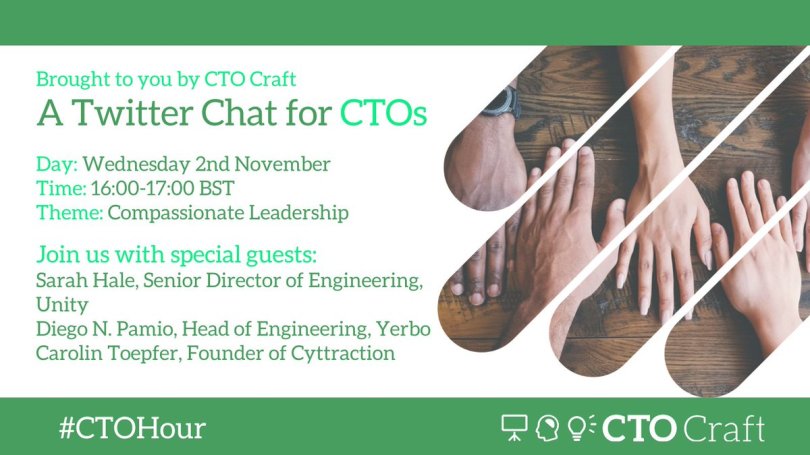
Back in November 2022, I participated in CTO Craft’s ‘CTO Hour’ to discuss Compassionate Leadership. This was all captured on Twitter, however, as the wise Scott Hanselman has said multiple times, it’s important to own your words rather than keep them in a walled garden that you don’t own or control, so I am re-posting my answers here.
- Q1: How do you find the balance between compassion and performance in your leadership style?
- Q2: What are the best ways to spot compassion in a new hire when interviewing?
- Q3: How can you remain compassionate while staying resilient as a leader?
- Q4: What can happen if you’re not compassionate enough with your team?
- Q5: What about self-compassion? Can you be an Engineering Leader without it?
- Q6: Can you be compassionate without being transparent?
- Q7: Can you be too compassionate as a leader?
Q1: How do you find the balance between compassion and performance in your leadership style?
First, I think it probably helps to define what compassionate leadership is and isn’t.
It *isn’t* being ‘too nice’, passive, an excuse to opt out of giving meaningful constructive feedback or a way to avoid making hard decisions. 🧵 1/6 #CTOHour
For me, compassion is having and demonstrating empathy for others, actively seeking to understand their perspectives and motivations and genuinely wanting to make their lives better. 🧵 2/6 #CTOHour
It is possible to be an _effective_ leader whilst also being a compassionate one. 🧵 3/6 #CTOHour
It’s all about doing the hard things, such as giving tough feedback, making difficult decisions that disappoint people, or even having to lay people off, in a human-centric way – with empathy and respect. 🧵 4/6 #CTOHour
I think it’s challenging to be effective in the long term without demonstrating at least _some_ compassionate leadership behaviours. For me, compassionate and effective leadership go hand in hand. 🧵 5/6 #CTOHour
Without compassion, you may be effective in driving short term results, but if you want to create a sustainable, high-performing team for the long haul, you need to be compassionate too. People will always remember how they are treated. 🧵 6/6 #CTOHour
Q2: What are the best ways to spot compassion in a new hire when interviewing?
I find that folk who practise compassionate leadership tend to talk about the human impact of their decisions without specific prompting or probing. 🧵 1/5 #CTOHour
As an example, if they are talking about a challenging decision that had to be made, or a production outage, did they talk about how that affected the humans involved (be that staff or customers), or steps they took to minimise negative impact on humans next time? 🧵 2/5 #CTOHour
When talking about navigating conflict, did they demonstrate empathy towards the individuals involved? 🧵 3/5 #CTOHour
A question I like to ask in interviews is: ‘What does being an effective leader look like to you?’ (sometimes I use ‘good’ instead of ‘effective’).🧵 4/5 #CTOHour
There is no ‘correct’ answer, as having diff types of individuals & leaders in a team is important, but that q can spark an interesting discussion & reveal whether compassion is something they prioritise or at least recognise (even if they don’t use the exact word)🧵 5/5 #CTOHour
Q3: How can you remain compassionate while staying resilient as a leader?
It can be challenging to be both resilient and compassionate, especially for sustained periods of time (such as during the covid-19 pandemic). 🧵 1/8 #CTOHour
Things that help me include: self-reflection, peer support, some leadership tools/frameworks, friends, and an incredibly supportive partner. 🧵 2/8 #CTOHour
I’ve learned over the years to spot the early warning signs of when I am slipping on compassion and resilience, so after a tense zoom or challenging situation, I make sure to take a moment to stop and reflect. 🧵 3/8 #CTOHour
Was I being the type of leader I want to be? If not, why is that? What do I need to do differently? 🧵 4/8 #CTOHour
I also lean on my peers for support, as people to bounce ideas off, get advice or feedback from, and to check-in on how my actions are landing vs. how I perceive them to be landing (there are different ways to do that, this is just one of many). 🧵 5/8 #CTOHour
I’m also a @CTOCraft Mentoring Circle member. I find these to be invaluable, particularly in building up my own resilience. It’s very reassuring to know that ~12 other folk have had comparable experiences, and it’s a great way to share tips and insights. 🧵 6/8 #CTOHour
Finally, I want to recommend @Lara_Hogan’s fantastic book – ‘Resilient Management. It’s a treasure trove of actionable advice. It’s one of those books I find myself often referring back to. 🧵 7/8 #CTOHour
Same with @joulee’s ‘The Making of a Manager’ – another excellent book – especially for when I’m gut-checking my actions or paths forward. 🧵 8/8 #CTOHour
Q4: What can happen if you’re not compassionate enough with your team?
People are less likely to share ideas when they don’t feel understood and supported by their leaders – this in turn can reduce creativity & innovation in their work, which can lead to poorer customer outcomes, which might hinder the growth of the business. 🧵 1/4 #CTOHour
Leading with compassion tends to foster compassion in others. If a leader demonstrates that they value and reward acting with compassion when delivering business outcomes, it will shape how the folk around them behave. 🧵 2/4 #CTOHour
People want to be heard and understood. Compassion – demonstrating empathy for others, actively seeking to understand their perspectives and motivations, then taking action – simply leads to happier humans, which is better for your business and society as a whole. 🧵 3/4 #CTOHour
If you don’t use compassion in your leadership, you will likely still get results, especially in the short term, but will likely struggle to sustain a high performing team over a longer period of time. 🧵 4/4 #CTOHour
Q5: What about self-compassion? Can you be an Engineering Leader without it?
Self-compassion is something I certainly struggle with, and I am an engineering leader, so, I guess ‘yes’, However, I also think self-compassion is important for being a resilient and effective leader. 🧵 1/9 #CTOHour
A phrase that has always stuck with me, and I find myself repeating often in tough leadership times is ‘you need to put your own oxygen mask on first, before attempting to help those around you’. 🧵 2/9 #CTOHour
Although I know in order to be an effective leader, I need to make sure I am physically and mentally okay, it can still be really hard to prioritise my own needs above others. 🧵 3/9 #CTOHour
So, it’s something I have to be actively conscious of, especially since actions speak louder than words, and I’m in a position of power. People will look to see what I _do_ not just what I say. 🧵 4/9 #CTOHour
If I don’t take time to look after myself – what kind of role model am I being? I talk a lot to my team about working in a sustainable way – making sure they know it’s okay (and encouraged!) for them to take sick/parental/compassionate leave… 🧵 5/9 #CTOHour
…that they shouldn’t work ridiculous hours – a work/life balance is important for avoiding burnout. But, if I don’t practise what I preach, I am undermining myself. 🧵 6/9 #CTOHour
I find @ScottHanselman’s article is super helpful for putting things into perspective ‘Software and saving babies‘ I’d highly encourage everyone to take a read.🧵 7/9 #CTOHour
So, in the spirit of leaving things better than when you found it – self-compassion is something I am trying to ensure my managers focus on as part of their own growth journey as they rise in seniority. 🧵 8/9 #CTOHour
My hope is that if they can learn how to have self-compassion earlier on in their leadership path, it will become a core part of their leadership toolbox, and will result in them being more successful at being self-compassionate when in very challenging situations.🧵 9/9 #CTOHour
Q6: Can you be compassionate without being transparent?
Transparency is key to helping people understand why something is happening and foster a trusting relationship. As leaders, we need to determine what is the appropriate level of transparency in any given situation. 🧵 1/5 #CTOHour
I believe in being transparent, but there are times where having a degree of opaqueness is needed in order to be effective and kind. 🧵 2/5 #CTOHour
Compassion is about demonstrating empathy, understanding a person’s perspectives and motivations and then acting on those insights with the person’s best interest in mind. 🧵 3/5 #CTOHour
Sometimes, acting with the person’s best interest means making a difficult decision. This is where compassion and transparency compliment each other. 🧵 4/5 #CTOHour
Being transparent about why you made the decision is important to make sure the person understands what is happening and why, and compassion is important in ensuring you’re making the most appropriate decision for the right reasons. 🧵 5/5 #CTOHour
Q7: Can you be too compassionate as a leader?
Hrm, this is an interesting question to answer. My initial response is ‘yes’ because as with most things, it’s all about everything in moderation. 🧵 1/7 #CTOHour
If you demonstrate too much compassion towards a single person, you may miss the opportunity to be compassionate with others, or perhaps shift towards being ineffective – being nice instead of kind, or shying away from making tough but needed decisions. 🧵 2/7 #CTOHour
I think there is a risk to being a compassionate leader when you belong to an underrepresented group in tech. I have experienced folk assuming I am less technical just because I care about the humans as well as business outcomes. It’s disappointing. 🧵 3/7 #CTOHour
The operating environment is important too. If you’re in a company that doesn’t value compassion in their leaders, then practising compassion will always be an uphill battle. 🧵 4/7 #CTOHour
You may make incremental improvements, but it will be limited. In that situation, if you’re in a position to do so, I would recommend finding a place that values your leadership style. 🧵 5/7 #CTOHour
At Unity, we not only list our values, but also how we expect folk to live them – with Empathy, Respect and Opportunity. 🧵 6/7 #CTOHour
Although I’ve always tried to demonstrate compassion as a leader, the fact it’s baked into Unity culture helps me be a compassionate leader, as well as making it easier for me to advocate and ensure those around me are practising compassionate leadership too. 🧵 7/7 #CTOHour
 Sarah Hale